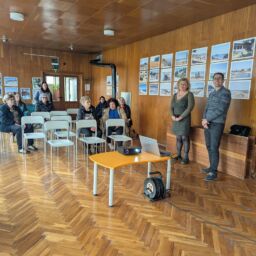
On 28 March, Global Libraries Bulgaria Foundation hosted the Educated Digital Citizens event at Sofia City Library to discuss what libraries can do to reaise the level of digital skills among the Bulgarian public. The event was part of the European All Digital Weeks 2025 campaign, being held between 17 March and 4 April in 22 countries.
“The European Commission’s goals are for 80 percent of European citizens to be digitally literate. Currently, the rate is around 56 percent. Bulgaria unfortunately is in 26th place, higher only than Romania, in terms of digital skills and the reach of digitalization into all spheres of public life,” commented Spaska Tarandova, Executive Director of GLBF before introducing the Bulgarian events for the 2025 campaign. Over 50 events have been organised by 16 regional libraries, two municipal libraries and four chitalishte. 21 cities, towns and villages are taking part: Sofia, Varna, Pleven, Lovech, Gabrovo, Plovdiv, Vratsa, Silistra, Kardzhali, Pazardzhik, Stara Zagora, Dobrich, Smolyan, Ruse, Targovishte, Vidin, Samokov, Dimitrovgrad, and the villages of Preslavtsi (Tutrakan), Durankulak (Shabla) and Botevo (Tundzha).
Ekaterina Zaharieva, European Commissioner for Startups, Research and Innovation greeted the event by video from Brussels: “For me, libraries have always been much more than simply places for books. They are centres of knowledge, curiosity and development, and now they have also become spaces for digital inclusion and lifelong learning.” She also remarked on her pride at seeing how libraries across the country are encouraging their users to become confident and responsible modern citizens, and expressed her belief that digital skills are crucial for feeling fulfilled as part of modern society.
“90 percent of jobs today require digital skills. Digital literacy is also key to protecting us from disinformation, thereby making democratic societies more resilient. However, only 36 percent of adults in Bulgaria have basic digital skills. This is well below the European average of 56 percent, which is also worryingly low in itself. The lack of digital skills limits our capacity to innovate and address global challenges, from climate change to the transformations of artificial intelligence and cybersecurity.” Ms Zaharieva added that the European Union has set ambitions goals for its Digital Decade Strategy, and emphasised that education and training, regardless of age, are essential for ensuring that no one is left behind at this time of profound economic and social transformation.
Svetoslava Toncheva spoke about the integration of digital content and education into the activities at Sofia City Library over the past decade, noting in particular the Digital Teen Lab, and IT literacry training for adults. The challenges the library faces are related to the lack of sustainable funding for providing and maintaining necessary equipment and not enough personnel – “We have difficulties attracting young people to work with us because funds are extremely limited and we can only offer them low salaries.”
Deputy Minister of Labour and Social Policy Natalia Efremova noted that today we no longer talk only about traditional citizenship, but also about digital citizenship. “Digital citizenship is a very complex subject. It is related to constantly having access to information while simultaneously being able to understand and process it correctly. Basic digital skills are not about knowing how to turn on a computer or open Google, but include far deeper knowledge and skills.” Regarding the role of libraries, “They can easily be considered as training providers. They already do this, and for free as far as I understand, within the framework of some projects. In the same way, libraries can register as training providers with the Employment Agency.” These trainings are paid for by the Employment Agency, who provide participants with electronic vouchers as they progress through the different skill levels. Over 100,000 people have already been issued such vouchers.
Deputy Executive Director of the Employment Agency Kristiyan Panov described several software systems currently under development – related to job searching, recruitment, professional orientation and retraining – which Bulgarians with sufficient digital competences will be able to navigate. “There are also our fellow citizens who do not have a computer at home or the skills to work well enough with phones or computers. Accordingly, they need a physical place to go and someone to help them at the initial registration and access stages of using these Agency services and portals. Libraries could be such places.”
Indeed, perhaps, the future of libraries lies in their being digital centres of knowledge, said Ivan Goychev – Deputy Mayor of Sofia Municipality for Digitalization, Innovation and Economic Development. According to him, libraries can also host trainings organised by businesses.
Bogdan Patashev, Head of the International Cooperation Department at the Ministry of Culture, presented part of the welcome address by the Minister of Culture Marian Bachev. “The 2024 Ministry of Culture programme, Technological Renewal, Technological Equipment and Promotion of Reading, Media and Information Literacy in Public Libraries has been an important step, “financing 35 regional and municipal libraries. At the same time, we have made significant progress on the Digitization of Museum Collections, Libraries and Archives project as part of the Recovery and Sustainability Plan. Recipients include the Bulgarian National Film Library, Bulgarian National Television (BNT), Bulgarian National Radio (BNR), the Bulgarian Telegraph Agency (BTA), the State Archives Agency, the E-Government Infrastructure Executive Agench, and various museums, galleries and libraries.”